Start with the fact that reframes everything else:
In the United States, anyone can call themselves a climbing guide. There is no federal licence, no legal training requirement, no board to strike anyone off. The AMGA states it plainly, a guide is not required by federal law to be trained in any way before guiding the public.
Which is exactly why you check three things, and why two of them are not "is he a good climber."
The Three Checks
1. Certification, scoped to the terrain you'll actually be on. 2. A land-manager permit, for the specific place you're going. 3. Liability insurance.
Most articles cover the first. The second is the one that determines whether your day is even legal, and almost nobody mentions it.
Certification: The Scope Is the Point
"AMGA-certified" is not a single thing. Each credential authorizes specific terrain, and a guide working outside their scope is a guide operating beyond what they were assessed on, and, often, outside their insurance.
| Credential | What it authorizes |
|---|---|
| Climbing Wall Instructor (CWI) | Artificial walls only |
| Single Pitch Instructor (SPI) | Single-pitch natural rock only, no multi-pitch, no significant scrambling or route-finding |
| Multi-Pitch Instructor (MPI) | Multi-pitch rock up to commitment Grade II, simple approaches and descents |
| Rock Guide | Complex rock terrain, any commitment grade |
| IFMGA / American Mountain Guide | Rock, alpine and ski, the top of the ladder |
So the question is not "are you certified?" It's "what are you certified for, and does that cover the route we're doing?"
A perfectly legitimate SPI is not certified to take you up a five-pitch route. If you book a multi-pitch day and your guide holds an SPI, something is wrong, and it may well be that nobody involved realised it.
On the IFMGA: it is not a separate European credential, and it is not "equivalent to" AMGA certification. AMGA is the sole US member of the IFMGA, and Americans earn the licence through AMGA by certifying in rock, alpine and ski. An IFMGA guide is the most qualified person you can hire, and plenty of them are American. Don't discount the credential because a guide is local.
The Permit: The Check Nobody Makes
Guiding commercially on public land requires authorization from the land manager. This is not optional and it is not a formality:
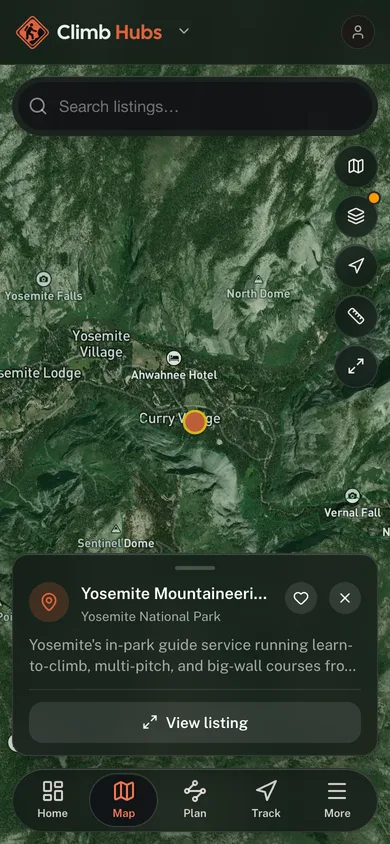
- National Park Service, a Commercial Use Authorization (CUA) or a concession contract. Which one varies by park, and it genuinely matters: Yosemite does not permit guided climbing under a CUA at all, it runs through a single concession, while Rocky Mountain National Park does issue climbing CUAs.
- US Forest Service, a Special Use Permit for all commercial outfitting and guiding.
- BLM, a Special Recreation Permit. These can be genuinely scarce: Red Rock Canyon issues only a handful of commercial climbing permits a year, by lottery.
Permits are area-specific. A guide permitted in one national forest has no authority in the next one, or in the national park down the road. Don't ask "do you have a CUA?". Ask the question that works everywhere:
"Are you permitted to guide in the specific area we're climbing?"
Unpermitted guiding is a real and ongoing problem in the industry. It is also a decent proxy for everything else: an operator willing to guide illegally is an operator making other decisions you can't see.
Insurance
Ask for proof of commercial general liability insurance. A legitimate service carries it, land managers require it as a condition of the permit, and AMGA accreditation audits it.
Note the interaction with scope: a guide operating outside their certification can void their own policy. Which means the SPI taking you up a multi-pitch route may be uninsured for the day, whether or not either of you knows it.
Individual Certification vs. Business Accreditation
Two different things, and worth knowing both:
Individuals hold AMGA certifications (the table above).
Businesses hold AMGA Accreditation, and accreditation is precisely the audit of everything this article is about. It requires the business to employ a certified guide or instructor for each type of terrain it operates in, to hold the right land-management permits and insurance, to have been running for three continuous years under the same ownership, and to meet standards on risk management and business practice.
"AMGA-accredited business" is therefore a stronger signal than any individual credential, because it means someone else already checked the permits and the insurance.
Wilderness Medicine
Expect a current Wilderness First Responder (WFR) plus CPR. It's an AMGA prerequisite for the MPI and for the Rock, Alpine and Ski Guide programs, so any guide on that track has one.
(The SPI is the exception: AMGA doesn't name a specific level, requiring instead that the instructor hold appropriate medical certification for where they work. Ask what they hold.)
Treat a guide with no wilderness medical certification as disqualifying.
The Questions to Actually Ask
- What AMGA certification do you hold, and does it cover this terrain?
- Are you permitted to guide in this specific area? Which permit?
- Are you insured? May I see a certificate?
- Is the business AMGA-accredited?
- What's your wilderness medical certification, and is it current?
- What's the guide-to-client ratio for this day?
- What's the plan if the weather turns, and what's the cancellation policy?
On ratios, a correction worth having. The AMGA does not set client ratios; its Scope of Practice governs terrain, not headcount. Ratios come from the land manager. Rocky Mountain National Park, for example, mandates a maximum group of 12 and standard ratios of 1:5 single-pitch, 1:2 multi-pitch, 1:3 basic alpine and 1:2 advanced alpine. If a guide offers to take you and three friends up a multi-pitch route, that's a question worth asking.
And on price: a full private day, one-to-one, realistically runs $400–525 in 2026, with cheaper regions (the Red River Gorge) nearer $240 and premium destinations past $600. Two clients typically pay $265–345 each. A number far below that band means somebody isn't paying for a permit, insurance, or certification.
Get the answers in writing: along with the itinerary, what's included, and the waiver you'll be asked to sign.
Red Flags
Vagueness about certification. "Our guides are all highly experienced" is not an answer to "what are they certified for."
"We don't need a permit." They do.
Suspiciously cheap. Guiding carries real costs: certification, insurance, permits, gear, travel. A price well below the local market means one of those is missing, and you can usually guess which.
Irritation at these questions. A good guide service answers them without blinking, because they've built a business on being able to.
And One Thing In Their Favour
You do not need any certification, experience, or gear to hire a guide. A good guide will take a complete beginner and give them a superb, safe day on real rock, and a guided day is, hands down, the best money in climbing for someone making the jump from the gym.
Just make sure the person you're roped to is certified for the ground you're standing under, permitted to be there, and insured. Those three answers take one email.