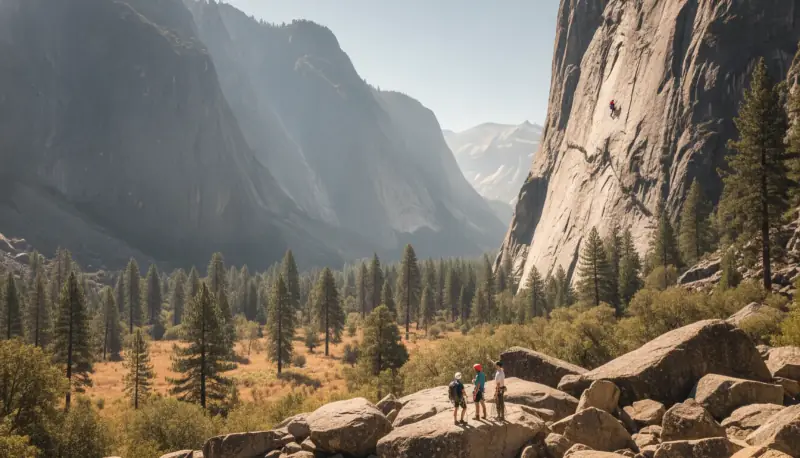
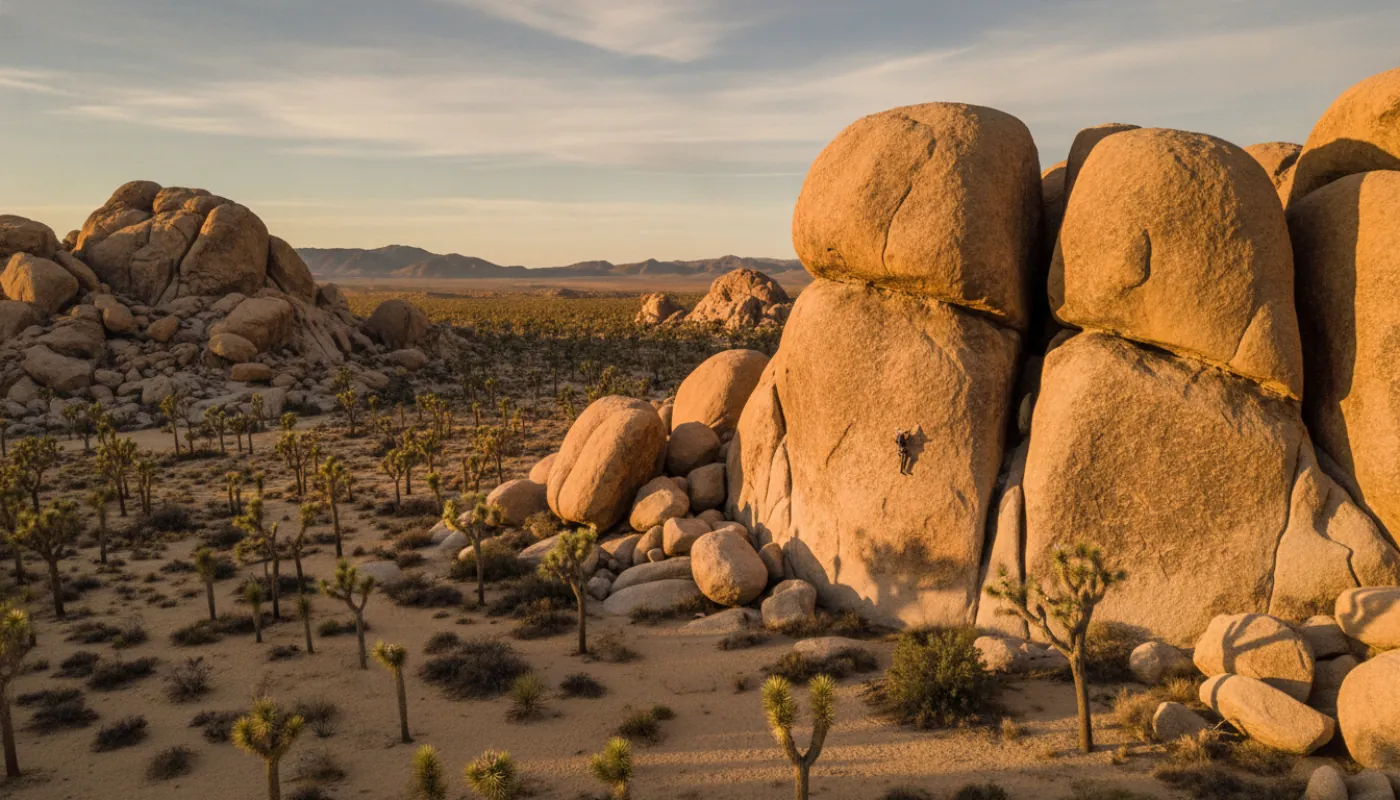
Joshua Tree has around 8,000 routes and 2,000 boulder problems, and it is one of the great climbing places on earth.
It is also, for a gym climber's first outdoor trip, a famously humbling choice, and most articles will not tell you that. So here's the honest version, because knowing what you're walking into is the difference between a brilliant week and a demoralising one.
Read This Before You Book
The grades are sandbagged, and not gently. A Joshua Tree 5.7 regularly shuts down climbers who cruise 5.10 in the gym. The old-school ratings, especially on routes graded before 2000, run something like three letter grades stiff by modern standards. This is not a comment on you. It's the place.
It's a trad, crack and slab venue. The NPS describes it as traditional-style crack, slab and steep face climbing. Beginner sport routes are genuinely scarce, and the bolted lines that exist are often runout, bolts twenty feet apart where a modern sport crag would put them six to ten. Some routes described as "sport" don't even have bolted anchors; you need trad gear to build one.
Which means JT demands more anchor and rope competence than a modern sport crag, not less. Anyone telling you it's an easy place to learn systems has it backwards.
The rock will eat your hands. It's monzogranite: coarse, crystalline, and abrasive like nothing in a gym. Bring tape, expect to bleed a little, and manage your skin.
So: is Joshua Tree a good first outdoor destination? As a place to learn crack technique, slab footwork and desert judgement, under instruction, it's superb. As a place to teach yourself to lead sport routes, it's one of the worst in America.
Hire a guide for your first day or two. This is the single best money you'll spend, and in JT it isn't a luxury purchase.
The Practical Facts
| Entrance fee | $30 per vehicle, valid 7 days ($25 motorcycle, $15 per person on foot/bike). The America the Beautiful pass ($80) covers it; a JT-only annual pass is $55 |
| Season | October through April. Summer is genuinely unclimbable, triple-digit heat, and the NPS closes trails and bans campfires for heat and fire risk |
| Cell service | None. Not "spotty." Download your maps before you arrive |
| Water | Four litres per person per day, plus more for cooling off, and note that the centre of the park has no potable water. Fill up at Black Rock, the West Entrance, or the visitor centre |
That water number is not padding. Joshua Tree's search-and-rescue team spends its season on heat-illness calls.
Other desert realities: rattlesnakes, flash floods in the washes, and a sun that will cook you on a 60°F day.
Where to Climb, and Where Not To
Go to Hidden Valley and Quail Springs. They're the heart of the main climbing area, they're close to the road, and the classics there have seen thousands of ascents.
Do not go to the Wonderland of Rocks. Climbers call it "the Wanderland" for a reason: it's roughly twelve square miles of trail-less, road-less backcountry with unmarked approaches. People need rescuing from it every year after getting disoriented. It is emphatically not where you learn to climb outside, and any guide that tells you its approaches are "flagged" has never been there.
Camping: The Part That Actually Trips People Up
Hidden Valley Campground is the climbers' campground. It sits right in the middle of the main climbing area, and it's still first-come, first-served, with cash-only registration.
That matters, because it fills by about 9 a.m. on weekdays and by sunrise at weekends. Plan to arrive early, or plan to sleep elsewhere.
| Campground | Booking | Fee |
|---|---|---|
| Hidden Valley | First-come, first-served (cash) | $25 |
| Belle, White Tank | First-come, first-served | $25 |
| Jumbo Rocks, Ryan | Reservation (Recreation.gov, 6 months out) | $30 |
| Indian Cove, Black Rock, Cottonwood | Reservation | $35 |
And note: they are not all year-round. Ryan, Belle and White Tank close for the summer; Indian Cove, Black Rock and Cottonwood partially close from June into late August.
Closures: Check Before Every Trip
Seasonal raptor closures run roughly late February through July, and they close specific formations outright while birds are nesting. The list changes annually, and it is long.
There are also permanent closures, some for cultural sites, some for resource protection.
Check the NPS climbing page before you go, every time. Climbing a closed formation is how areas get closed permanently, and Joshua Tree's climbing access is actively managed.
On bolts: the NPS requires a permit for placing, replacing or removing any fixed anchor, in all circumstances, hangers must be rock-coloured, and the Park Service does not inspect or maintain the bolts. Some of the fixed gear out there is very old. Inspect everything, and remember you cannot fully verify a bolt by looking at it.
What to Bring
Beyond the standard outdoor rack:
- A helmet. Old bolts, loose flakes, and slab falls that slide.
- Tape, and gloves if you're crack climbing. The rock is a cheese grater.
- Approach shoes with real rubber, the slab walk-offs are the crux of many days.
- A stiffer, tougher pair of climbing shoes than you'd take to a limestone sport crag. JT eats rubber.
- More water than you think. See above.
- A headlamp, because the descent always takes longer than the climb.
If you're bouldering, crash pads and a brush, and be honest about height, because JT's "short" boulders have hard, uneven landings.
About the Crack Sizes
Since you'll be racking for this: a hand crack is roughly two to three inches, the range of a #1 to #3 cam. A 0.75-inch crack is a thin finger crack, not a hand crack, and if you rack expecting the former you'll arrive with the wrong gear for the route.
Which is another argument for going with someone who knows the place.
The Honest Recommendation
Come in November, or February through April. Get a campsite at Hidden Valley by sunrise, or stay in town. Hire a guide for your first day and let them show you what a JT 5.7 actually feels like. Climb well below your gym grade and don't take it personally.
Then spend a week learning to jam, learning to trust your feet on featureless slab, and learning that the desert doesn't care how strong you are.
That's the trip worth taking. It's just not the trip most articles are selling you.