The best climbing gym for your first year is almost always the one you'll actually go to, close to home or work, with people you like. Everything below is a tiebreaker.
But there are a few facts worth having before you sign anything, because the pricing is higher than most guides admit and one common piece of "safety" framing is exactly backwards.
What It Actually Costs in 2026
| Real range | |
|---|---|
| Monthly membership | $78–$140, most big-city gyms land at $101–$140 |
| Initiation fee | $59–$100, standard, and rarely mentioned upfront |
| Day pass | $23–$37 |
| Intro class | $39–$50 (often includes a day pass and rentals). Some chains run free daily intro sessions |
| Private coaching | $85–$150/hour |
| Shoe rental | Usually $5–10, or bundled |
If you've seen "$60 a month," that number is a few years stale. Budget realistically: first month is typically membership plus initiation, so $140–$240 to walk in the door.
Do the arithmetic before you commit. At roughly $30 a day pass and $110 a month, a membership pays for itself at about four visits. If you're not going to climb weekly, buy day passes.
The Three Things You Can Do In There
Bouldering. Short walls, no rope, thick mats. You climb "problems" graded on the V-scale.
Top-rope. The rope is already anchored above you. Falls are short and undramatic, that's the design.
Lead. You clip the rope as you climb. Bigger falls, real belay skill, requires a separate certification.
Auto-belays deserve a specific warning. They're the retractable devices that let you rope-climb alone, and they're brilliant, but the classic accident is forgetting to clip in. People walk up, climb, let go at the top, and fall the full height. Every gym has a clip-in checkpoint and a warning sign for exactly this reason. Clip in. Check it. Every single time.
Bouldering Is Not the "Safe" Option
Here's the framing that needs correcting.
You will read that bouldering is lower-consequence because the walls are shorter and the mats are thick. The injury data says the opposite: bouldering is the high-acute-injury discipline in a climbing gym.
Ankle sprains are the single most common gym climbing injury, lower limbs account for around two-thirds of injuries, and falls from the middle and upper part of the wall, the top-out zone of that "short" wall, cause nearly half of injury falls.
Mats reduce consequence. They don't remove it. So:
- Learn to fall: land on both feet, roll backwards, don't stick a hand out.
- Learn to downclimb rather than jumping off from the top every time.
- Look before you drop. Landing on another climber is a genuine and common injury mechanism.
None of that means don't boulder. It means don't boulder under the illusion that the ground is optional.
Understanding the Grades Before You Feel Bad
Gyms use two scales, and beginners routinely conflate them:
- Bouldering: the V-scale: VB, V0, V1, V2 …
- Ropes: the YDS, 5.6, 5.7, … 5.10a, 5.10b …
They do not line up the way people assume. V0 is roughly equivalent to 5.10a, not 5.6. So a climber who's happily top-roping 5.8 and getting shut down on V0 is not failing at anything; those are simply not the same difficulty. Bouldering starts hard.
And one more thing to file away for later: gym grades run soft. When you climb outside, expect to drop a half to a full grade. Your gym 5.10a is roughly an outdoor 5.9.
What to Look For in the Building
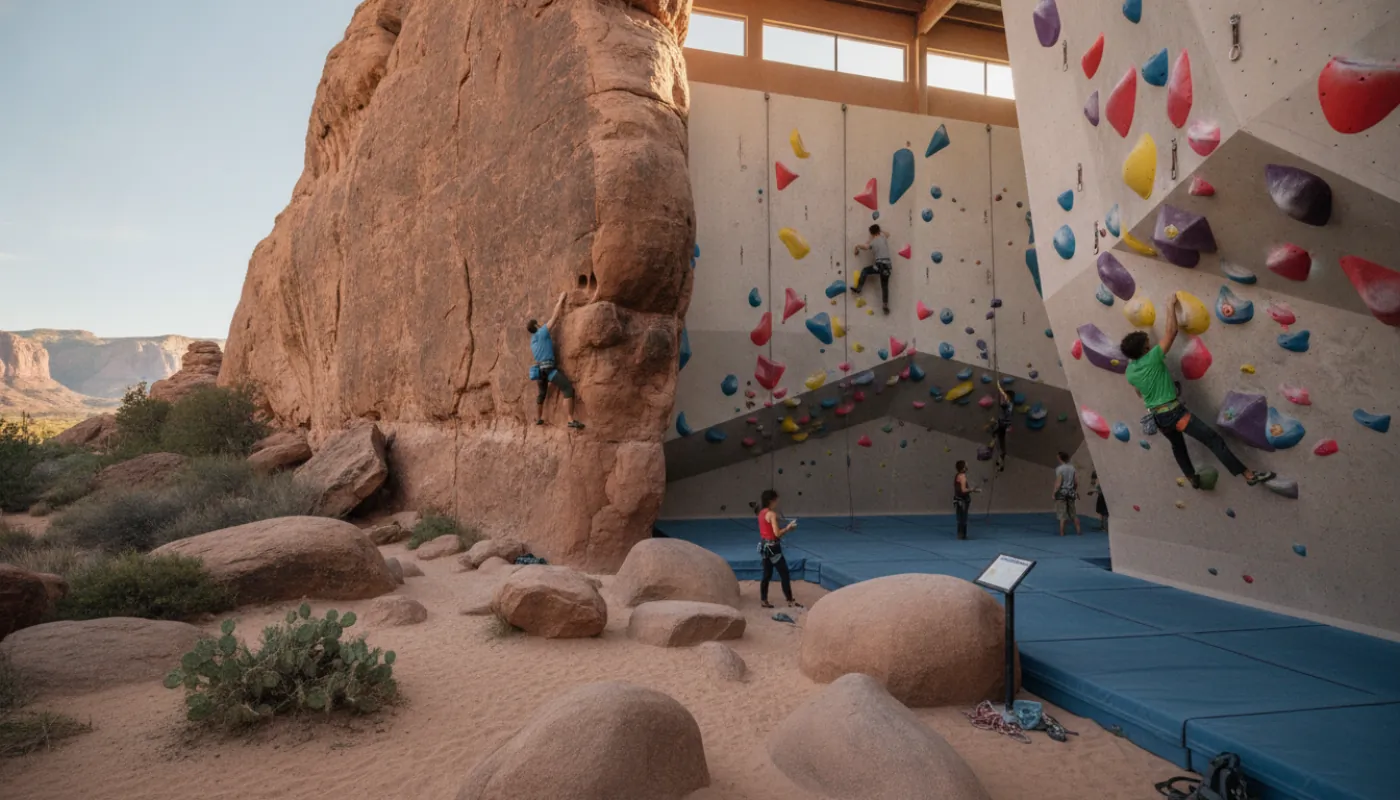
A good spread of easy routes. Count the routes at the bottom of the grade range, VB/V0/V1 on the boulders, 5.6 to 5.9 on the ropes. A gym with two easy routes and forty hard ones will bore you into quitting.
Varied wall angles, and know what each one teaches:
- Slab and vertical walls train footwork and balance. This is what a beginner most needs.
- Overhanging walls train power, and will gas a new climber in fifteen minutes.
A gym that's all steep is a gym that will make you strong and technically hopeless. Start on the slabs, no matter how uncool they feel.
Fresh route setting. Ask how often they reset. Every few weeks per section is healthy; a gym with routes up for six months is a stale gym.
Real coaching. Intro classes, technique clinics, a beginner series. A $40 group class that fixes your footwork in week one is worth more than months of flailing, and more, honestly, than a $130 private.
Belay Certification
Every commercial gym requires a belay check before you may belay, with a separate lead certification for lead climbing. This is universal: it's a baseline, not a quality signal, so don't treat it as a differentiator between gyms.
What is a signal: whether the staff watch the floor, whether they'll correct a dangerous belay, and whether anyone says hello.
What to Buy, and What to Rent
Buy shoes early, this is the one purchase that changes your climbing. Rental shoes are stretched, dead, and shaped like boats. A first pair costs $90–$140; get them fitted snug but not agonising, and don't buy the aggressive downturned pair the internet recommends. Flat, comfortable, all-day shoes are correct for year one.
Buy chalk and a bag ($20–40 together). Cheap, personal, worth it.
Rent the harness until you know you're staying. When you do buy, that's a $50–100 decision.
Buy nothing else. You do not need a rope, a belay device, quickdraws, or a crash pad to climb in a gym. Resist.
The Real Test
Go in on a weekday evening, when it's busy. Watch for thirty seconds.
Does anyone talk to each other? Is someone giving a stranger beta? Does the staff member behind the desk look up?
You will improve fastest at the gym where you make friends, because climbing partners are how you get better, and eventually they're how you get outside. Pick the room where that feels likely. Everything else is negotiable.