A grade is one climber's opinion, ratified by other climbers who agreed. That's the whole mechanism. Understanding what a grade doesn't tell you is more useful than memorising the scale.
The Yosemite Decimal System
American routes use the YDS, which starts as a scale of terrain, not difficulty:
| Class | What it is |
|---|---|
| 1 | Walking |
| 2 | Hiking on uneven ground |
| 3 | Scrambling; you'll use your hands |
| 4 | Steeper scrambling; a fall could be serious; some parties rope up |
| 5 | Technical climbing, you rope up |
Everything a climber talks about lives in Class 5, subdivided after the decimal: 5.0 through 5.15 and counting. The scale is open-ended by design. 5.15d is the current ceiling, not a limit.
Letter grades (a/b/c/d) begin at 5.10. Below that, a route is just 5.7 or 5.8 (although you'll also see plus and minus signs, and here's a correction to something commonly written: +/− is used at and above 5.10 too (5.10+, 5.11−), and in some regions), the Gunks and much of the East Coast, it's used instead of letters entirely.
The scale is also profoundly non-linear. The gap between 5.6 and 5.7 is nothing like the gap between 5.13d and 5.14a.
The Protection Ratings: The Part That Can Hurt You
A grade tells you how hard the moves are. It tells you nothing about what happens if you fall. That's a separate, and much more important, set of letters:
| Rating | Meaning |
|---|---|
| G / PG | Protection is good |
| PG-13 | Adequate, but with some runout or marginal placements |
| R | Protection is inadequate. Expect a long fall, with injury potential |
| X | A fall likely means death or serious injury. No meaningful protection |
A 5.8 X will kill you and a 5.13a PG will not. If you take one thing from this article, take that. Read the protection rating before the number, every time, and understand that the number is the part everyone brags about, while the letter is the part that decides the consequences.
There's also a Roman-numeral commitment grade (I–VII) describing how long a route takes: Grade I is an hour or two, Grade VI is multi-day.
The V-Scale (Bouldering)
Invented by John "Verm" Sherman at Hueco Tanks in the late 1980s and published in 1991, the V-scale is open-ended and integer-based: V0, V1, V2 …
Two notes on notation:
- It extends below V0 with VB and V0− for beginner problems.
- Above V0, it doesn't take plus signs. "V2+" is not a thing. (V0+ and V0− exist at the bottom; the rest are whole numbers.)
The top end: V17 is the hardest grade confirmed by repeat, Burden of Dreams, first climbed by Nalle Hukkataival in 2016 and repeated by Will Bosi in 2023. A first V18 has been proposed (Exodia, by Elias Iagnemma in Italy, in late 2025) and awaits repeat.
For calibration, elite bouldering lives at V14 and up. V4 to V6 is solid intermediate territory.
Converting Between Systems
| YDS | French sport | Font (bouldering) | V-scale |
|---|---|---|---|
| 5.9 | 5c | – | – |
| 5.10a | 6a | 6A | V0 |
| 5.10d | 6b+ | 6B+ | V1 |
| 5.11b | 6c+ | 6C | V2 |
| 5.12a | 7a+ | 7A | V3–V4 |
| 5.13a | 7c+ | 7B+ | V5–V6 |
| 5.14a | 8b+ | 8A | V11 |
| 5.15a | 9a | – | – |
The one to internalise: V0 is roughly 5.10a. A boulderer's "easy" grade is a roped climber's first real milestone, and the two scales do not start in the same place.
The Grade Conversion Nobody Warns You About: Gym to Rock
Here's the one that matters most, and gets stated backwards constantly.
Gym grades are soft. Outdoor grades are stiff. Moving outside, expect to drop half a grade to a full grade, often more.
- Your gym 5.10a is roughly an outdoor 5.9.
- Your gym V2 is roughly an outdoor V0 or V1.
Not the other way round. If you climb 5.10 in the gym, start on outdoor 5.8s and 5.9s and expect to work for them.
And that's before you factor in the things a gym removes entirely: holds you have to find rather than spot by colour, feet that are smears rather than plastic, rests you have to notice, and the sustained mental load of being on real rock.
Why Grades Are Inconsistent Anyway
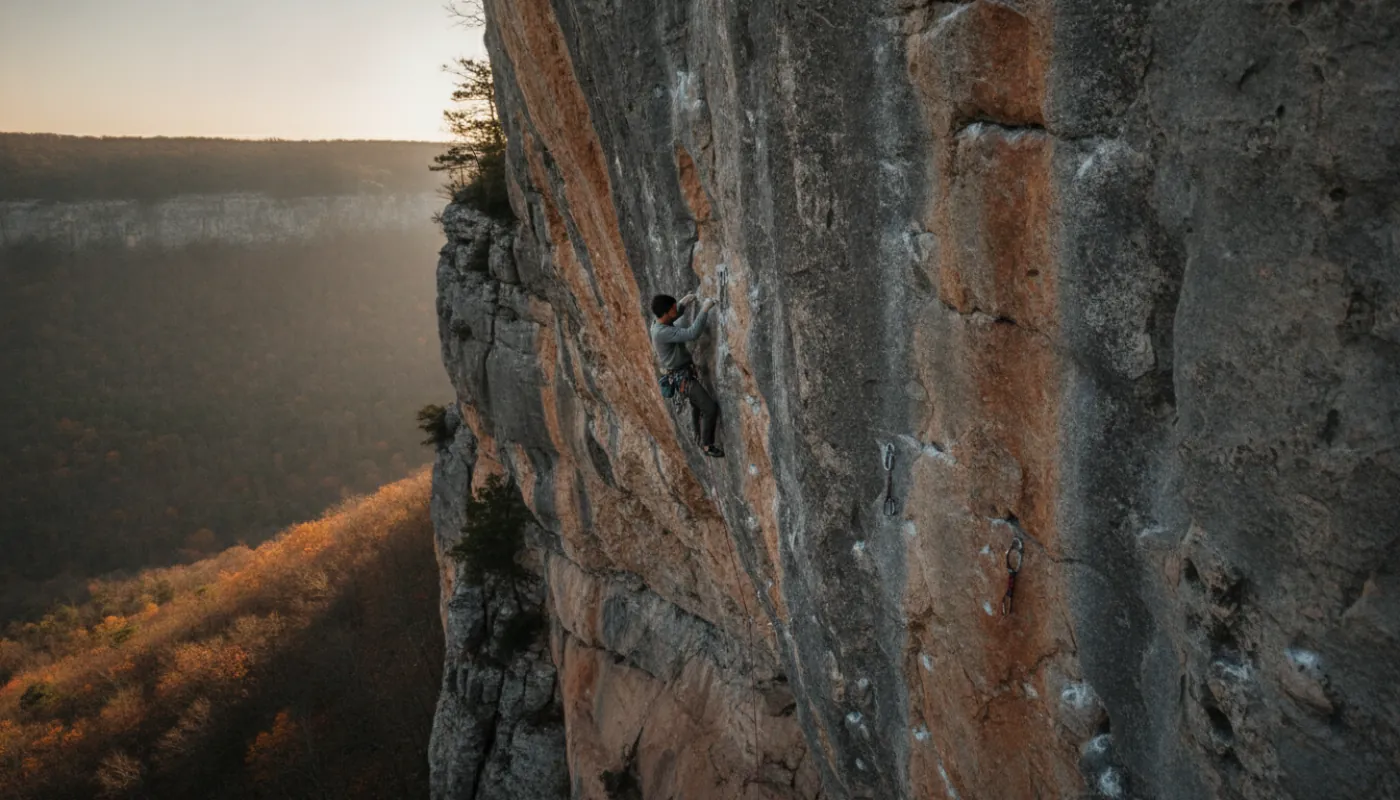
Regional sandbagging is real. Joshua Tree, the Gunks, and Yosemite are famous for grades that humble visitors, a JT 5.7 is not a Red River Gorge 5.7. Old routes, graded decades ago, run particularly stiff.
Body type matters. A reachy route is easier if you're tall; a crimpy one favours small fingers. A grade is a consensus averaged over bodies unlike yours.
Style matters. Sport and trad at the same number are different propositions, because on trad you're also placing gear, and being pumped while fiddling in a cam is its own difficulty that the number doesn't capture.
Trad, incidentally, means placing your own protection, not your own "anchors." They're different things.
How to Actually Use Grades
As a filter, not a verdict. A grade tells you roughly whether a route is worth trying today. It doesn't tell you whether it suits you, whether it's safe, or whether you'll enjoy it.
Read the protection rating and the description first. "5.9 R, loose rock, sparse pro, long runout to the second bolt" is a completely different day from "5.9, well-bolted, fun."
And don't let the number become the point. The climbers who last are the ones chasing good movement on good rock, not a number to say at parties. The number is a byproduct.