Every climber who outgrows the gym asks the same question: what now? The answer is usually one of three words (sport, trad, or alpine), and the difference between them is not really about difficulty. It's about who puts the protection in the wall, and what happens when you fall.
The Three Disciplines, Precisely
| Sport | Trad | Alpine | |
|---|---|---|---|
| Protection | Permanent bolts, drilled and fixed. You clip quickdraws to them | Removable gear (cams, nuts, hexes), that the leader places and the follower takes out, leaving no trace | Mostly trad gear, plus snow and ice protection |
| What you carry | A rope, ~12 quickdraws, two lockers for the anchor | A rack of cams and nuts, plus slings and the rope | All of the above, plus ice tools, crampons, and the mountain kit |
| What decides your safety | The quality of the bolts, and your rope systems | The quality of your placements, and your judgement | All of that, plus weather, altitude, descent and time |
The dividing line is removability. Trad gear goes in, holds a fall, and comes back out. Bolts stay forever. That's the actual definition, and it's the one most articles miss.
And the categories bleed. Plenty of trad routes have a bolt where nothing else will protect a blank section, and bolted belay and rappel anchors are common on trad climbs. Mixed routes (part bolted, part gear), are an ordinary, named thing. Anyone who tells you a trad route by definition has no bolts is oversimplifying.
Sport Climbing: The Movement Puzzle
The bolts are already there, so your attention narrows to one question: can you do the moves? That's the appeal, and it's why sport is where most climbers build their hardest climbing.
You work a route, fall off it, lower, rest, and try again. The progression is legible and addictive.
But "bolted" does not mean "safe," and the sport-climbing accident data is very specific about why.
Falls are longer than you think. You fall at least twice the distance you are above your last bolt, plus slack, plus rope stretch, plus however far your belayer gets pulled off the ground. Three feet above the bolt is a six-foot fall minimum, and with bolts commonly five to ten feet apart, ordinary lead falls run fifteen to twenty-five feet. Nobody gets caught "just below the clip."
Low on the route, that arithmetic puts you on the ground. Many sport routes do not protect you from the deck for the first twenty feet. This is what a stick clip is for, and using one is not cheating, it's what experienced sport climbers do.
And the thing that actually kills sport climbers is the descent. The AAC has documented roughly eighty lowering incidents, including fatalities, per decade, and more than half were caused by the end of the rope passing through the belay device. The rest cluster around lower-versus-rappel miscommunication.
So the two habits that matter more than any amount of strength:
Close the system, a stopper knot in the free end of the rope, every single time. And agree on the ground whether you're lowering or rappelling, then confirm it again at the anchor. These two things prevent most single-pitch fatalities.
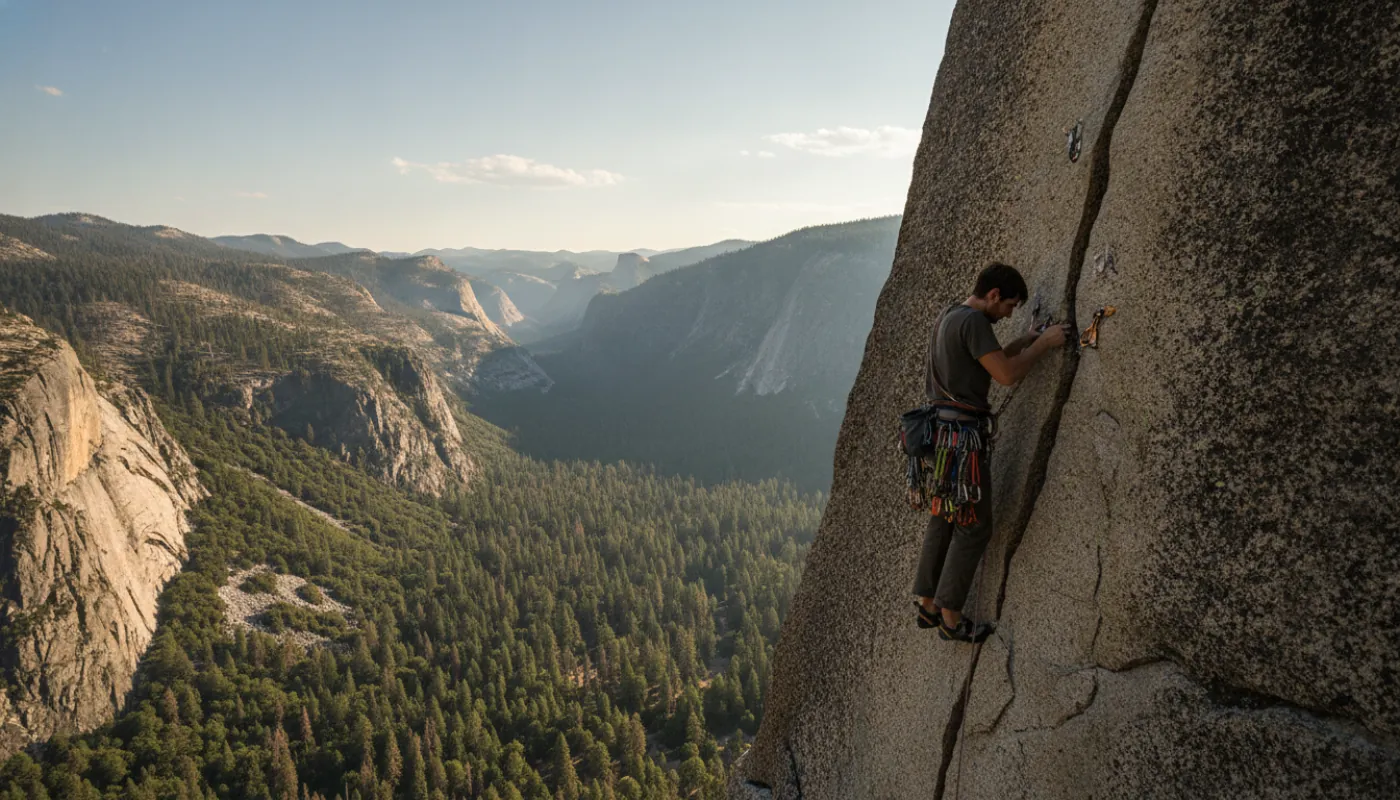
Trad Climbing: You Build the Net
In trad, you solve the movement and the protection at the same time. Is there a crack? Will a cam bite there? Is the rock behind it hollow? How far above my last piece am I willing to be?
A trad placement can rip. That is the fundamental difference. A bad cam walks out of its slot or blows the flake it's behind, and a poorly-built line of gear can zipper, pieces pulling in sequence from the bottom up as the fall loads them. Your first piece is doing more work than you think.
This is why trad cannot be self-taught, and why this article will not teach it to you. Gear placement is a physical craft learned in person, on real rock, from someone experienced, with your placements inspected and criticised. Read every book you like, then go get taught. The standard path is: follow experienced leaders and clean their gear (you'll learn more about placements by removing them than by reading about them), take a course, then lead easy routes far below your limit.
Is trad "more dangerous"? The honest answer is more interesting than the slogan. Trad climbers do report more accidents, but exposure, terrain and objective hazard drive much of that, and sport climbers take far more falls. Meanwhile, the dominant fatal mode on single-pitch routes, the lowering and rappelling errors above, is human error common to both disciplines. As the AAC puts it, every protection failure that can happen in sport can also happen in trad; trad simply adds vastly more variables.
What trad buys you is the rest of the world: any crack, any wall, anywhere, without waiting for someone else to bolt it.
Alpine Climbing: The Mountain Is the Problem
Alpine climbing is not "trad on a big rock." It's rock, snow, ice and mixed ground, on terrain where the climbing is often the easy part.
The technical difficulty spans everything from scrambling to hard modern mixed climbing: it is not, as you'll sometimes read, defined by moderate 5.3–5.5 rock. What defines it is the compound problem: weather that turns in an hour, altitude that degrades your body and your judgement, a descent you can't see from below, and a rescue that is not a phone call away.
Alpine is graded on a compound system for exactly that reason, an overall commitment grade alongside separate rock, ice and mixed grades.
It's where most climbers go after competence in sport or trad, and it's the discipline where a guide or a mountaineering school pays for itself fastest.
Wear a Helmet in All Three
Rockfall, ledges, and getting flipped upside down by a rope behind your leg. Sport crags have all three. This is not an alpine-only piece of kit.
So Where Should You Start?
Most climbers go gym → sport → wherever they like. Sport is the lowest-friction entry to outdoor rock: the protection is in, so you can focus on learning the systems (belaying outdoors, closing the system, cleaning anchors, assessing bolts), without simultaneously learning to place gear.
If trad is the goal, start early and start following. Get on experienced leaders' ropes. Clean their gear and ask why each piece went where it did. Take a course. The people who become good, safe trad leaders almost all did this for a season or two first.
If alpine is the goal, get trained properly (rock, snow, rope rescue, weather, descent), and go with people who've done it.
And whichever you pick: the difference between climbers who enjoy a thirty-year career and climbers who get hurt in their second season is almost never strength. It's whether they learned the systems from somebody who knew them, or invented them on the wall.