Skill drills
How to Tie Climbing Knots
A handful of knots carry most of a day at the crag: the one that ties you to the rope, the one that ties the rope to the anchor, the one that lets you belay with nothing but a carabiner, and the one that keeps you from going off the end. These drills put a harness, a locking carabiner and a rope end in front of you and walk you through each knot one decision at a time, with what the accident reports say goes wrong.
- Free
- No signup
- Interactive 3D
- Sourced from the UIAA, the American Alpine Club, the BMC and Petzl
4 techniques
Pick a technique
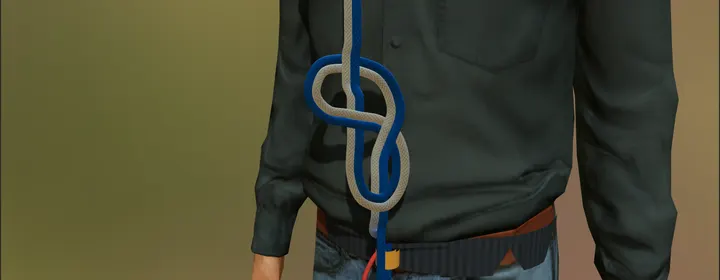 Start hereFigure 8 follow-throughThe knot that ties you to the rope: a figure 8 in the rope, the end through your harness, then followed back through the 8, strand beside strand.5 steps
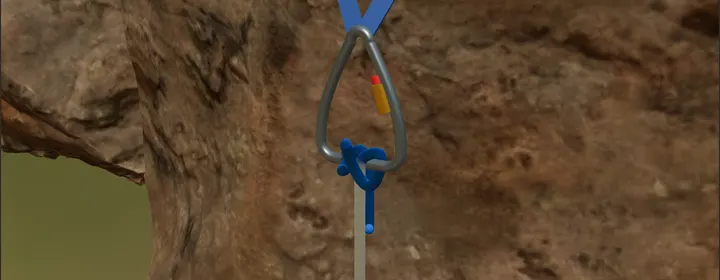 Technique 2Clove hitchTwo turns round a locking carabiner with a diagonal over them: the adjustable hitch for tying the rope to an anchor.5 steps
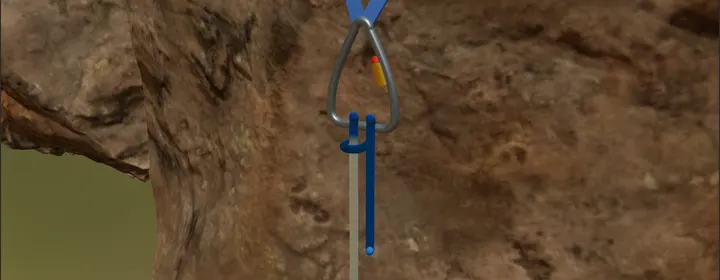 Technique 3Munter hitchA belay or a lower with no device: the rope over a pear-shaped locking carabiner, a bight round the climber's strand, and that bight clipped back through.5 steps
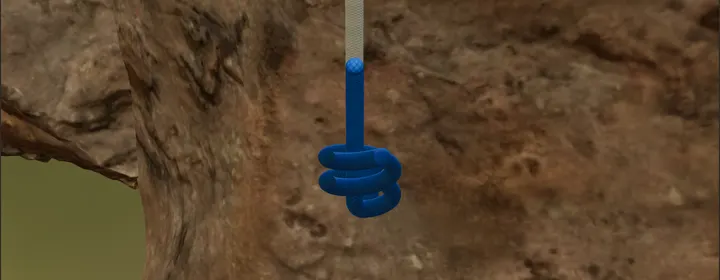 Technique 4Stopper knotA bulky knot in the end of the rope, so a rappel or a lower stops at the knot instead of running off the end.5 steps
Every time
Rules for every climb
- Check every knot yourself, then have your partner check it, every time.[1, 2, 12]
- Finish a knot before you do anything else. Distraction runs through the incomplete tie-in reports.[12, 13]
- Close the system: a stopper knot in the end of the rope, or the belayer tied in.[17, 18]
- Locking carabiners at every critical connection, and locked.[4, 10]
Watch & learn
Climbing knots on video
Picked from our video library. These are other creators' videos, so where one differs from the drill, the drill's sourced steps are the ones to follow.
Best Knots for Climbing—The 5 Knots Every Climber Should Know || REI
REI
0How to Tie Into a Climbing Harness (With a Figure 8 Knot) || REI
REI
0Rock Climbing: How to Tie a Clove Hitch
REI
0Basic & Intermediate Outdoor Climbing: 11. Stopper Knots for Belay & Rappel | Climbing Tech Tips
Climbing Tech Tips
04 Knots Every Climber Should Know | Climbing Daily Ep.991
EpicTV Climbing Daily
0How to attach the rope to your harness
BMC TV
0
FAQ
Climbing knot questions
Learn it hands-on
Climbing knots are learned hands-on. Browse guide services, climbing schools and gyms near you, and have a pro check your knots.
Find climbing guides and schoolsSources
Where the checkable claims above come from. Rules and figures change, so confirm anything you are about to rely on against the source itself.
- UIAA Safecom answers your questions: Figure-eight knotsUIAA Safety Commission (theuiaa.org)
- CORAX harness: Technical NoticePetzl (petzl.com)
- Belay loop and tie-in points: where do I attach my lanyard, my belay device and my rope?Petzl (petzl.com)
- Locking carabiners: Technical NoticePetzl (petzl.com)
- Examples of dangerous carabiner loadingPetzl (petzl.com)
- Building a belay anchor and belaying on a bolted multi-pitch routePetzl (petzl.com)
- Harness HandbookEdelrid (edelrid.com)
- The basics: climbing indoorsBritish Mountaineering Council (thebmc.co.uk)
- Alpine skills: 6 tips for multipitch abseilingBritish Mountaineering Council (thebmc.co.uk)
- Summer Mountaineering Leader Field HandbookAlpine Club of Canada (alpineclubofcanada.ca)
- Incomplete Tie-In, Fall on Rock, California, The NeedlesAmerican Alpine Club, Accidents in North American Climbing (publications.americanalpineclub.org)
- Fall on Rock: Incomplete Tie-In KnotAmerican Alpine Club, Accidents in North American Climbing (publications.americanalpineclub.org)
- Incorrect Tie-In: DistractionAmerican Alpine Club, Accidents in North American Climbing (publications.americanalpineclub.org)
- Rappel Error, No Knots on Ends of RopeAmerican Alpine Club, Accidents in North American Climbing (publications.americanalpineclub.org)
- Rappel Error: Uneven Ropes, Stopper Knot UntiedAmerican Alpine Club, Accidents in North American Climbing (publications.americanalpineclub.org)
- Know the Ropes: RappellingAmerican Alpine Club (publications.americanalpineclub.org)
- Know the Ropes: LoweringAmerican Alpine Club (publications.americanalpineclub.org)
- Know the Ropes: Cleaning Sport RoutesAmerican Alpine Club (publications.americanalpineclub.org)
- Know the Ropes: Crafty Rappel TechniquesAmerican Alpine Club (publications.americanalpineclub.org)
- Climbing merit badge pamphletScouting America (filestore.scouting.org)
- TC 3-97.61 Military Mountaineering (Nov 2025), Internet Archive copyHeadquarters, Department of the Army (archive.org)
- WILLIAM locking carabinerPetzl (petzl.com)
- RockLock Screwgate CarabinerBlack Diamond (blackdiamondequipment.com)
- Which belay system should be used to belay a leader directly off the anchor on a multi-pitch route?Petzl (petzl.com)
- Rappel Failure: Munter Hitch Unscrewed a Locking CarabinerAmerican Alpine Club, Accidents in North American Climbing (publications.americanalpineclub.org)
- Continental Field Manual: References (Knots)U.S. Antarctic Program, National Science Foundation (usap.gov)
- Boat Crew Handbook: Seamanship Fundamentals (BCH 16114.4)U.S. Coast Guard (hosted by the Coast Guard Auxiliary) (rdept.cgaux.org)